
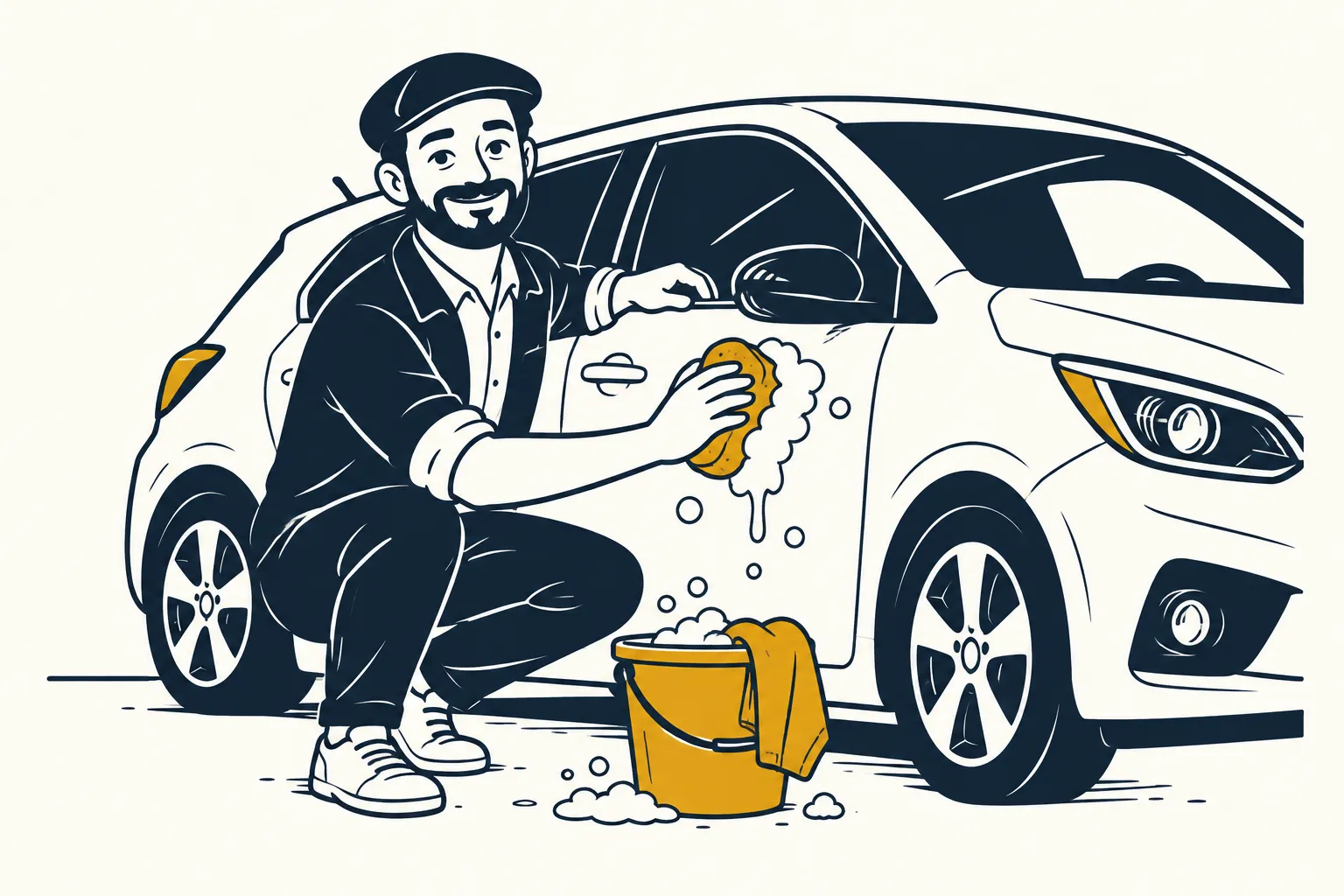
Washing the car yourself looks like free money: a bucket, some soap, and the $15 stays in your pocket. Is it cheaper to wash your car at home? Per wash, yes; overall, it depends. The real cost includes the gear you buy to do it properly, the supplies you use each time and, in some places, the rules that say you cannot do it at all. One number decides whether the gear pays back: how often you wash. At once a month it pays for itself in about a year. At a few times a year it may never make sense, and the car wash stays the better deal.
Is it cheaper to wash your car at home? Per wash and overall
The saving per wash is simple: the price of the car wash you would otherwise use, minus what the home wash costs in supplies. With a $15 automatic wash and about $2 of soap and towel wear per home wash, each wash at home keeps $13.
The gear is the part people underestimate. A bucket and a mitt cost little. A proper setup, with a pressure washer or a foam cannon, microfiber towels and good soap, can run to a couple of hundred dollars. That purchase has to be paid back by the $13 per wash before any saving begins. With $180 of gear, that takes 14 washes.
So the question is how long 14 washes takes you. Once a month, it is a little over a year. Twice a month, about seven months. Four times a year, more than three years, by which point the gear may need replacing before it has paid for itself. The calculator does this with your own prices and your own frequency.
Frequency decides almost everything
Here is the same $180 of gear and the same $13 saving per wash, at different frequencies:
| Washes per year | Time to pay back $180 of gear | Saved per year after |
|---|---|---|
| 4 | about 3.5 years | $52 |
| 8 | about 1.8 years | $104 |
| 12 | about 1.2 years | $156 |
| 24 | about 7 months | $312 |
Chart
Years to pay back $180 of car wash gear
$15 car wash replaced, $2 of supplies per home wash: $13 kept each time.
Source: Worked example; enter your own prices and frequency in the calculator
Frequency is the only variable that moves the answer this much. The price of the car wash matters, and so does the price of the gear, but a household that washes twice a month and one that washes four times a year are making two completely different decisions with the same equipment.
Two cars, one set of gear
The break-even changes for a household with two cars, and in a good way. The gear is bought once and used on both, so the number of washes doubles while the purchase stays the same. Two cars washed once a month each make 24 home washes a year: at $13 kept per wash, $180 of gear pays back in about seven months instead of fourteen, and the household keeps about $312 a year after that.
The same logic applies to anything else the gear cleans. A pressure washer used on the car twelve times a year and on the deck, the patio furniture and the bikes a few more times is doing work you would otherwise pay for or buy other tools for. The calculator only counts car washes, so for a household that will use the gear more widely, its answer is conservative. Enter the combined number of car washes for all the household’s vehicles, and treat the rest as a bonus that makes the purchase easier to justify over the years you will own it.
Your own numbers
Enter what you pay at the car wash, how often you go, what a home wash costs you in supplies and what the gear would cost.
Mr Deal's calculator
Washing the car at home: when does the gear pay off?
Enter what you pay at the car wash, how often you go, and the gear you would buy. Frequency is the only number that really moves the answer.
Some cities and homeowner associations restrict washing cars at home, and drought rules can ban it temporarily. Check yours before buying anything: the calculation only makes sense where it is allowed.
Water: what the EPA says
Water is where home washing has a reputation problem, and the EPA’s WaterSense program puts numbers on it. A hose left running can waste 6 gallons a minute, while washing from a bucket and sponge uses only a few gallons; WaterSense recommends washing with water from a bucket, or using a commercial car wash that recycles its water (EPA WaterSense).
Commercial washes vary a great deal too. The EPA’s WaterSense at Work guide for facilities cites in-bay automatic washes using as much as 74.1 gallons of fresh water per vehicle without a reclaim system, and as little as 19.1 gallons with one (EPA WaterSense at Work). A careful bucket wash at home uses less water than either; a long rinse with an open hose can use more.
The cost of that water on your bill is usually small next to the price of a wash, though water, sewer and trash service rose 4.8% over the year to August 2026 according to the Bureau of Labor Statistics. The practical lesson is to wash from a bucket, rinse quickly, and use a nozzle that shuts off when you let go.
Runoff, and why some places restrict home washing
The bigger environmental issue is not the amount of water but where it goes. Soapy water from a driveway flows into the street and into storm drains, which in most places lead straight to streams and rivers without treatment. The EPA’s guidance on vehicle washing notes that commercial car washes often recycle their water or must treat it before sending it to the sanitary sewer, which is why they are considered safer for waterways than washing on pavement (EPA).
That is the reason behind the local rules. Some cities and homeowner associations limit or ban washing cars at home, and drought restrictions can ban it temporarily. Before buying anything, check your city’s rules and your HOA’s; the calculation only makes sense where home washing is allowed. Where it is, washing on the lawn or gravel rather than pavement lets the water soak in instead of running to the drain.
The gear that pays, and the gear that doesn’t
The cheapest setup that does a good job is two buckets, a wash mitt, a pH-neutral car wash soap and a couple of microfiber towels. Dish soap is a common shortcut, but car wash soap is formulated for automotive paint and wax, which is why detailers recommend it. A bucket with a grit guardaff. keeps the dirt you rinse off the mitt at the bottom, instead of back on the paint.
Drying is where scratches and water spots happen. A large microfiber drying towelaff. absorbs water in one pass without dragging grit across the paint, and it is the purchase that makes the biggest difference to the result for the least money.
A pressure washer is the expensive part, and it is optional. If you do buy one, the number to look at is the flow in gallons per minute. Flow is what rinses the car and decides how long you spend; the pressure figure on the box is what gets quoted in advertising, and it matters less for a car than for stripping a deck.
Best for: washing the car at home twice a month or more
Electric pressure washer with hose reel
- Check the GPM figure first, not the PSI
- A hose reel stores it without kinks
- Also cleans the deck, patio furniture and bikes
- Pays back in about 7 months at 24 washes a year
The catch: Some cities and HOAs restrict home car washing. Check before you buy.
Current price and availability on Amazon
As an Amazon Associate, this site earns from qualifying purchases. It costs you nothing extra, and it does not change the verdict: when the numbers say a purchase never pays for itself, that is what you will read.
Soap is the one consumable that adds up. A concentrated pH-neutral car wash soapaff. used at the dilution on the bottle lasts many washes and keeps the supplies figure in the calculator low, which is what keeps the break-even short.
What a home wash takes, step by step
A home wash that protects the paint follows a simple order. Rinse the whole car first to lift loose dirt, working from the top down. Wash one panel at a time with a mitt dipped in soapy water, rinsing the mitt in the clean-water bucket before going back to the soap, so grit does not get dragged across the next panel. Do the wheels and lower panels last, with a separate mitt or brush, because that is where the heaviest dirt is.
Rinse again, from the top down, and dry right away with a large microfiber towel before the water spots in the sun. Washing in the shade, or early or late in the day, makes that easier. The whole routine takes about forty-five minutes once it is familiar, which is worth putting next to the drive to a car wash and the wait in line.
When the car wash is cheaper
The calculator will sometimes conclude that the car wash is the cheaper option, and there is no shame in that answer. It happens when you wash rarely, when the gear you have in mind is expensive, or when the wash you replace is already cheap, such as a basic automatic wash or a self-service bay where you pay a few dollars in quarters.
It also happens when time has a price. A home wash takes most of an hour; a drive-through takes ten minutes. For someone who values that hour, a cheap automatic wash or a membership used often can be the better deal even if it costs a little more per wash. The point of the calculation is to know the gap, not to insist on doing everything yourself.
Memberships, the option in between
Many car washes now sell unlimited monthly plans. They change the comparison, and sometimes they win it. The calculation is the same as for a gym: divide the monthly price by the number of washes you really use. If that cost per wash is below what a home wash costs you once the gear is amortized, the membership is the better deal, and it comes with no gear to store and no rules to check.
A membership is also the natural choice where home washing is restricted, or in winter in places where road salt calls for frequent washes and the driveway is frozen. As with a gym, the trap is the plan that keeps running after the habit has stopped: check the cost per wash every few months.
Winter, road salt and the underside of the car
In states that salt their roads, washing is not only about appearance. Salt left on a car’s underside and wheel wells can speed up corrosion, which is why many drivers wash more often in winter, and why a car wash with an underbody rinse can be worth it in those months even for someone who washes at home the rest of the year. A driveway at freezing temperatures is not a good place to wash a car anyway, both for the water and for the person holding the hose.
If you wash at home in a salted-road state, an undercarriage cleaner attachmentaff. for a pressure washer rinses the underside without crawling under the car, on a mild day and where home washing is allowed.
This is where frequency comes back into the calculation. A household that washes at home from spring to fall and uses a car wash in winter will see a slower payback on its gear than the table above suggests, because some of the year’s washes are still bought. Enter only the washes you would really do at home.
Where car washing fits among the everyday services
Car washing follows the same pattern as the other services this site runs through a break-even: a small expense repeated, and a purchase that pays back only if it is used often enough. It sits with hair clippers, a coffee maker and a home gym in the guide to doing it yourself, which ranks them by how quickly the object pays back.
It is also a small line in a much bigger one. What a car really costs per mile, depreciation, insurance, gas and upkeep included, is in the article on the cost per mile of a car, and the cheapest maintenance habit of all is in tire pressure and gas mileage. The page of savings calculators lists every other expense worth running through the numbers.
Frequently asked questions
- Is it cheaper to wash your car at home?
- Per wash, yes: soap and towels cost a couple of dollars against the price of a car wash. Whether it pays overall depends on the gear you buy and how often you wash. Replacing a $15 wash twelve times a year, with $2 of supplies per wash, $180 of gear pays for itself after 14 washes, a little over a year, and saves about $156 a year after that. At four washes a year it would take more than three years.
- How much does it cost to wash a car at home?
- Mostly supplies: car wash soap, microfiber towels and, if you use one, the electricity for a pressure washer, which is small. Water is the other input. The EPA's WaterSense program notes that a hose left running can waste 6 gallons a minute, while a bucket and sponge use only a few gallons.
- Is it illegal to wash your car in your driveway?
- In some places it is restricted. Some cities and homeowner associations limit or ban home car washing, mainly because soapy water running into storm drains reaches streams untreated, and drought rules can ban it temporarily. Check your city's rules and your HOA before buying equipment.
- Do car washes use less water than washing at home?
- It depends on the wash and on how you wash at home. The EPA's WaterSense at Work guide cites in-bay automatic washes using as much as 74.1 gallons of fresh water per vehicle without a reclaim system, and as little as 19.1 gallons with one. At home, a bucket uses a few gallons, while a hose left running can waste 6 gallons a minute.
- Is a pressure washer worth it for washing a car?
- Only if you wash often enough for it to pay back, and if home washing is allowed where you live. When you compare models, look at the flow in gallons per minute, which decides how fast the car rinses, rather than the pressure figure on the box. A pressure washer also cleans decks, patio furniture and bikes, which adds to its value.
- Is an unlimited car wash membership worth it?
- Divide the monthly price by the number of washes you really use. If the membership costs less than the washes you would otherwise pay for, it is worth it, and it can beat buying gear for home washing. The calculator on this page gives the home alternative so you can compare.
Who wrote this
Baptiste S.
Founder and writer · bs-media
I am not a financial adviser or an economist. I keep the books of an ordinary household, and I got tired of tip lists that never put a number on anything. So I work the other way round: I start from the expense, find the public data that says what it really costs, work out how long the object meant to cut it takes to pay for itself, and publish the result — including when it says to buy nothing.
- I start from public data — federal fuel prices, the Consumer Price Index, Energy Star ratings — and I say where every figure comes from.
- Every calculation shows its assumptions. If your usage differs from my example, the calculator gives you your own break-even point.
- I say when a purchase never pays for itself, including the best-selling product in its category.
- Credit, investing, insurance and public benefits are out of scope and referred to the competent body.
Read next
Is a Coffee Maker Worth It? The Break-Even in Cups
Is a coffee maker worth it? The price of a home cup at the government's average for ground coffee, the cups until the machine pays back, and when it never does.
Are Hair Clippers Worth It? Haircuts to Break Even
Are hair clippers worth it? How many haircuts until they pay for themselves, what you keep each year after, and the cuts that should stay with your barber.
Home Gym vs Gym Membership: When Equipment Wins
Home gym vs gym membership: what each visit really costs you, when home equipment pays for itself, and the order of steps that avoids paying for both at once.
Is a Chest Freezer Worth It? The Payback Math
Is a chest freezer worth it? What you save stocking up on sales, what the electricity costs in your state, and the one habit that decides whether it ever pays.