
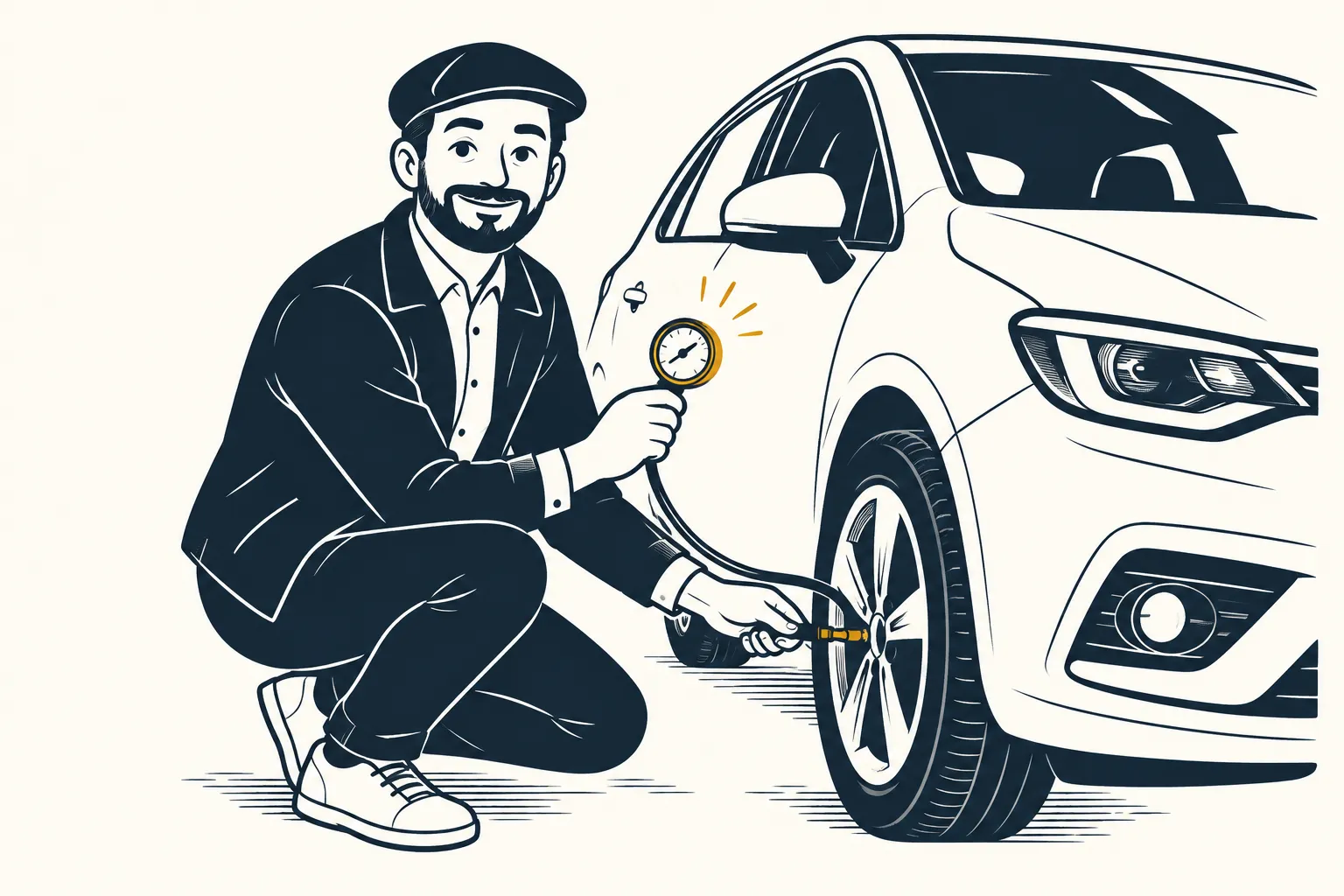
Twenty-four dollars. That is what a 5 psi shortfall on all four tires costs over a whole year, in a 25-mpg car driven the typical 13,500 miles, at this week’s gas prices. The subject of tire pressure and gas mileage is full of promises of big savings, and the government’s own figure says something more modest: about 0.2% of your mileage per psi. That does not mean the habit is worthless. It means it is worth it for a reason other than the one you are usually given.
Tire pressure and gas mileage: what the government actually measured
The number to start from comes from fueleconomy.gov, the site run jointly by the Department of Energy and the Environmental Protection Agency. Its maintenance page gives two figures, and they are worth reading carefully.
The first: you can improve your gas mileage by about 0.6% on average, and up to 3% in some cases, by keeping your tires inflated to the proper pressure. The second: under-inflated tires lower gas mileage by about 0.2% for every 1 psi drop in the average pressure of all tires (fueleconomy.gov).
Notice the words “average pressure of all tires”. One soft tire at 30 psi on a car that calls for 35 is a 5 psi shortfall on one tire, but a 1.25 psi shortfall on average. The mileage loss follows the average. That is why a car with one visibly low tire wastes less gas than people fear, and why a car with four slightly low tires, which nobody notices, can waste more.
Notice also what the figures are not. They are not 10%, and they are not “a free tank a year”. Those numbers circulate, but they do not appear in the federal guidance. At 0.2% per psi, even a 10 psi shortfall on all four tires, which is a lot, costs about 2% of your gas.
What low tires cost you in a year, in dollars
Percentages hide the stakes, so here they are in money. The profile: 13,500 miles a year, close to the Federal Highway Administration’s average for a licensed driver, in a car that gets 25 mpg. That is 540 gallons a year, or about $2,418 at $4.478 a gallon.
Under-inflation means buying more gallons for the same miles. If your mileage drops by a share p, you need 1 / (1 − p) times the gas. Applied to that profile:
| Average shortfall, all tires | Mileage lost | Extra gas per year | Cost per year at $4.478/gal |
|---|---|---|---|
| 2 psi | 0.4% | 2.2 gallons | $9.71 |
| 4 psi | 0.8% | 4.4 gallons | $19.50 |
| 6 psi | 1.2% | 6.6 gallons | $29.37 |
| 8 psi | 1.6% | 8.8 gallons | $39.32 |
| 10 psi | 2.0% | 11.0 gallons | $49.35 |
Chart
What low tires cost in gas per year
13,500 miles a year at 25 mpg, regular at $4.478 a gallon (EIA, week of Sept. 21, 2026).
Source: fueleconomy.gov (0.2% per psi), EIA weekly retail prices
Twenty to fifty dollars a year is real money, and it is money lost for nothing. It is also not the kind of figure that changes a household budget on its own. Keep that in mind when you read a headline about tire pressure; then keep reading here, because the fuel cost is the smaller half of the story.
How tires end up low without anyone noticing
Nobody decides to drive on soft tires. They get there by themselves, slowly, and the mechanisms are documented. NHTSA material on tire pressure monitoring notes that tires lose on the order of 1 psi a month through normal permeation, and that seasonal temperature swings cost about 1 psi for every 10°F drop in outside temperature.
Put the two together and the calendar does the rest. A car set to the right pressure on a warm afternoon in September, and not checked again, can be 5 psi low by a cold morning in December: three months of slow loss plus a 20-degree drop. That is squarely in the middle of the table above, without a nail, a leak or any warning.
The worst timing is also the most common one. The first real cold snap of the year tends to arrive just before the longest drives: Thanksgiving and the December holidays, when a loaded car covers hundreds of miles in a weekend. A car that set off 5 psi low and fully loaded wastes more than the table suggests, because weight and low pressure add up, and it does so on exactly the trips where a tire failure would hurt most. If a holiday road trip is on your calendar, the check belongs in the same week as the gift list, and the gas for the trip belongs in the holiday budget, not on a card in January. Most owner’s manuals give a higher pressure for a fully loaded car; that is the one to use before you leave.
Then there is the warning light. Since the 2008 model year, new cars have to carry a tire pressure monitoring system, and the federal standard, FMVSS No. 138, requires it to warn when a tire is 25% or more below the pressure on the placard (NHTSA). On a car that calls for 35 psi, the light comes on around 26 psi. A tire can therefore sit 7 or 8 psi low, costing gas and tread every mile, while the dashboard stays silent. The light is a safety net for serious losses, not a maintenance schedule.
Check it cold, once a month: the method that works
NHTSA’s recommendation is simple: check tire pressure at least once a month, with the tires cold. Cold means before driving, or after the car has sat for a few hours. The reason is physics: driving warms the air inside the tire and raises the reading, so a tire that reads 35 psi after twenty minutes on the highway may really be at 32 when cold.
That is the flaw in the most natural habit, which is to check at the station on the way somewhere. You arrive with warm tires, the gauge on the air hose says they are fine, and they are not. If you must check at the station, note how far the station is: a mile or two barely warms the tires; fifteen miles of highway does.
The right target is on the sticker in the driver’s door jamb. fueleconomy.gov is explicit that the maximum pressure molded into the sidewall is not the number to use: it is the most the tire can safely hold, not what your car was designed around. The door-jamb value accounts for the car’s weight, handling and braking.
Here is the calculation with your own car and your own state’s price. Measure your four tires cold, average how far they are below the sticker, and enter it.
Mr Deal's calculator
What under-inflated tires cost you in gas
Measure your four tires cold, average how far they are below the pressure on your door-jamb sticker, and enter it below with your own driving.
Rule used: about 0.2% lower gas mileage for every 1 psi drop in the average pressure of all tires (fueleconomy.gov, U.S. Department of Energy and EPA). Gas: EIA weekly average for your state.
The one tool that pays for itself in months
Checking pressure takes an instrument, and the simplest one fits in a pocket. A handheld gauge read on a cold tire, in your driveway, beats the gauge on a gas station hose for two reasons: you read the tire at the right moment, and you read it with the same instrument every time, so the numbers are comparable from month to month.
On the example profile, a 5 psi correction recovers about $24 a year in gas. Whatever the gauge costs where you buy it, the calculator above turns its price into months; in almost every case it pays back within the year on gas alone.
Best for: checking pressure once a month, cold
Digital tire pressure gauge
- Reads in a second on a cold tire, in your driveway
- The same instrument every month: readings you can compare
- More reliable than a station hose gauge after a drive
- Fits in the glove box
The catch: Use the pressure on the door-jamb sticker, never the maximum printed on the tire.
Current price and availability on Amazon
As an Amazon Associate, this site earns from qualifying purchases. It costs you nothing extra, and it does not change the verdict: when the numbers say a purchase never pays for itself, that is what you will read.
If your usual station charges for air, or you simply want to top up at home in the morning, when the tires are cold, a portable 12-volt tire inflator with auto shut-offaff. makes the monthly check a two-minute job in your driveway. It pays back on the same gas saving as the gauge, only more slowly in proportion to its price: work that out before you buy it, with the calculator.
Where the real money is: tread, grip and the tire itself
The fuel figure understates what is at stake. NHTSA’s guidance explains that tires are designed to perform at a specific inflation pressure, and that under-inflation changes the shape of the tire’s footprint and the pressure it puts on the road, which degrades its ability to transmit braking force. An under-inflated tire also flexes more, runs hotter and wears faster on its shoulders.
That is where the arithmetic tilts. A set of tires is one of the larger maintenance bills a car produces, and AAA’s 2025 Your Driving Costs study puts maintenance, repair and tires together at 11.04 cents per mile for a new car (AAA fact sheet). Tires worn out months early because they ran soft cost far more than the gas figure above. So does a blowout on the highway, which is a safety matter before it is a money matter.
While you are down there with the gauge, look at the tread. A tread depth gaugeaff. tells you how much life is left, well before the wear bars molded into the grooves come level with the surface. Tread wearing faster on both edges than in the middle is the classic signature of tires that have been running under-inflated; wear in the middle points the other way.
Tire pressure among the other ways to save on gas
Put in its place, tire pressure is the cheapest lever on the car, not the biggest. The biggest ones are about miles and the car itself. AAA’s 2025 study found that a new car costs about 77 cents a mile to own and run at 15,000 miles a year, of which gas was only 13 cents at last year’s prices. That is why the most profitable decision is usually a trip not taken, and why the page on what a car really costs per mile is worth reading before any gadget.
The second big lever is the vehicle you drive. If you are due to replace a car anyway, the gap between 20 mpg and 35 mpg dwarfs anything tire pressure can do, and the question of whether an electric car pays off depends on exactly the same numbers: your miles, your gas price and what you pay each month. The full ranking of these levers is in the guide to driving for less.
Tire pressure stays on the list because it is free, takes two minutes and pays back even on the most modest estimate. There is one more product people ask about: external tire pressure sensors that screw onto the valvesaff. and show the pressure on a small screen all the time. They do not save more gas than a gauge, since the saving is capped by the same 0.2% per psi. What they remove is forgetting. That has a value, but it is not a value this site counts in dollars.
If gas is the line of your budget that has grown most this year, and at $4.48 a gallon it probably is, the personal inflation calculator shows how much of your own cost-of-living increase it explains, and the page of all savings calculators lists what else is worth running through the numbers.
Frequently asked questions
- How much does tire pressure affect gas mileage?
- Less than most tips claim, but measurably. According to fueleconomy.gov, run by the Department of Energy and the EPA, gas mileage drops by about 0.2% for every 1 psi drop in the average pressure of all four tires, and keeping tires properly inflated improves mileage by 0.6% on average and up to 3% in some cases. For a driver covering 13,500 miles a year in a 25-mpg car, a 5 psi shortfall costs about 5.5 gallons of gas a year, or roughly $24 at the national average price of $4.478 a gallon for the week of September 21, 2026.
- How often should I check my tire pressure?
- At least once a month, and with the tires cold, which NHTSA recommends. Cold means the car has not been driven for a few hours, or only a mile or so. Tires lose about 1 psi a month on their own and about 1 psi for every 10°F drop in outside temperature, according to NHTSA documents, so a car that was right in July can be several psi low by November without anything being wrong.
- Where do I find the right tire pressure for my car?
- On the sticker in the driver's side door jamb, sometimes in the glove box or on the fuel door, and in the owner's manual. fueleconomy.gov is explicit: do not use the maximum pressure printed on the tire's sidewall, which is a limit for the tire, not the right value for your car.
- Doesn't my tire pressure warning light already do this?
- Only for large losses. The federal standard for tire pressure monitoring systems, FMVSS No. 138, requires the warning to come on when a tire is 25% or more below the placard pressure. On a car that calls for 35 psi, that is about 26 psi: a tire can be 8 psi low, costing you gas and tread every mile, before the light says anything.
- Is a tire pressure gauge worth buying?
- Yes, and it is one of the fastest paybacks on this site. On the example profile, correcting a 5 psi shortfall saves about $24 a year in gas alone; the calculator on this page gives the payback for the price you see. The bigger return is on tire wear and grip, which the fuel figure does not count.
- Should I overinflate my tires to save gas?
- No. Over-inflation shrinks the contact patch between the tire and the road, which reduces grip and braking, and the gas saving is tiny. The right number is the one on the door-jamb sticker. If the manual gives a higher value for a fully loaded car, use that one when you are loaded, not a number of your own.
Who wrote this
Baptiste S.
Founder and writer · bs-media
I am not a financial adviser or an economist. I keep the books of an ordinary household, and I got tired of tip lists that never put a number on anything. So I work the other way round: I start from the expense, find the public data that says what it really costs, work out how long the object meant to cut it takes to pay for itself, and publish the result — including when it says to buy nothing.
- I start from public data — federal fuel prices, the Consumer Price Index, Energy Star ratings — and I say where every figure comes from.
- Every calculation shows its assumptions. If your usage differs from my example, the calculator gives you your own break-even point.
- I say when a purchase never pays for itself, including the best-selling product in its category.
- Credit, investing, insurance and public benefits are out of scope and referred to the competent body.
Read next
Cost Per Mile of a Car: What One Mile Really Costs
Cost per mile of a car: AAA's 2025 breakdown adjusted to today's gas price, what depreciation and insurance add, and a calculator for your own car's true cost.
Is an Electric Car Worth It? The Monthly Math
Is an electric car worth it against the car you already own? Gas vs charging at your state's prices, upkeep, the monthly payment, and the mileage where it pays.
Is a Chest Freezer Worth It? The Payback Math
Is a chest freezer worth it? What you save stocking up on sales, what the electricity costs in your state, and the one habit that decides whether it ever pays.
Is a Coffee Maker Worth It? The Break-Even in Cups
Is a coffee maker worth it? The price of a home cup at the government's average for ground coffee, the cups until the machine pays back, and when it never does.