
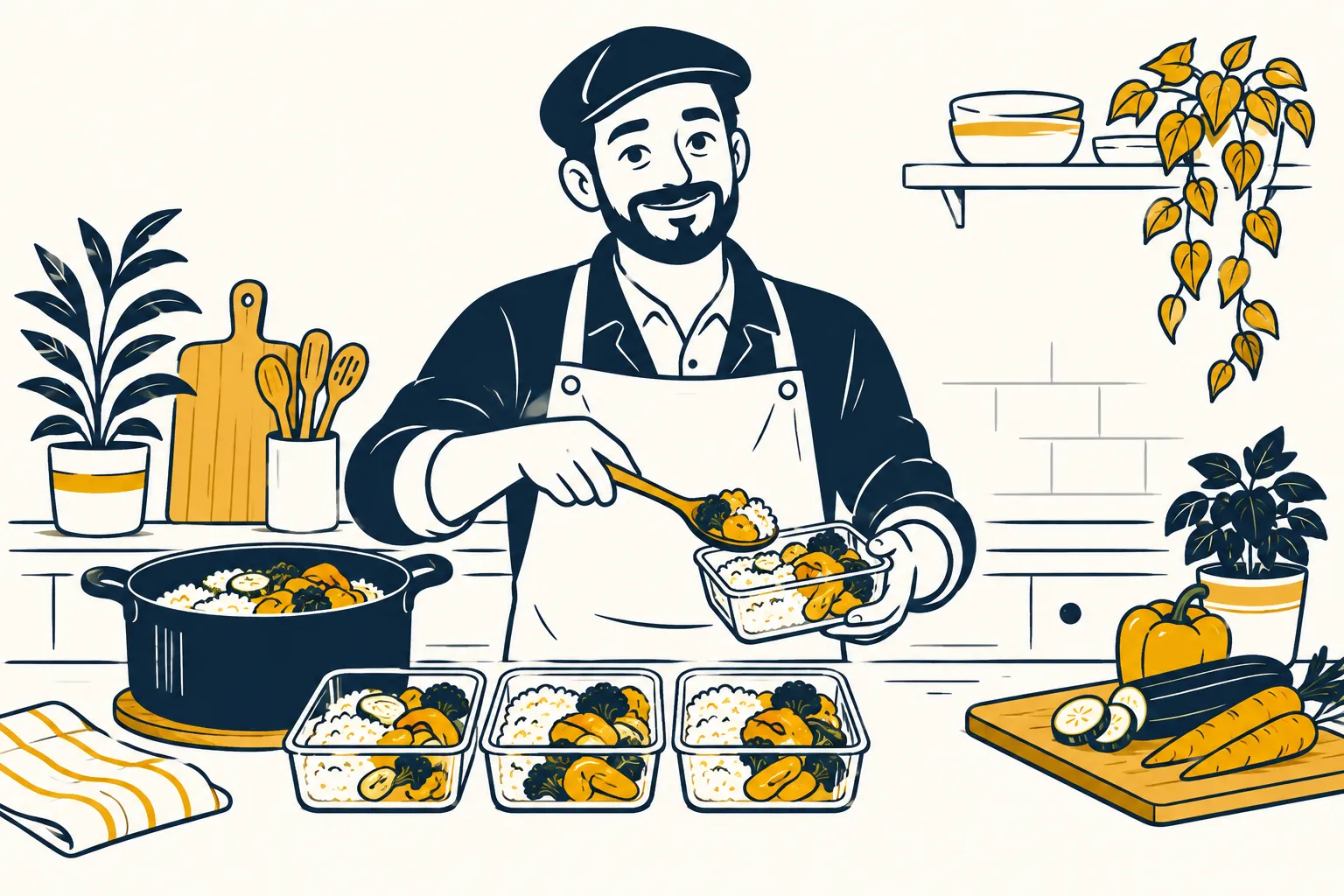
Is meal prep cheaper? Per portion, the answer is almost always yes, and by a wide margin: a home-cooked portion of rice, beans and vegetables costs a fraction of a takeout lunch. That answer is also the least useful one. The question that decides whether batch cooking belongs in your week is what the saving comes to per hour of your time, shopping and dishes included. Sometimes it is better paid than a second job. Sometimes it pays less than minimum wage.
Is meal prep cheaper? Count per portion, then per hour
The saving of a cooking session has a simple formula. Take the price of the meal each portion replaces, subtract the ingredients per portion, and multiply by the number of portions. Ten portions that each replace a $12 lunch, with $3.50 of ingredients in each, save $85.
Then divide by the time, and count all of it: the extra time at the store, the prep, the cooking, portioning into containers and the dishes afterward. If the whole thing takes two and a half hours, the session earns $34 an hour. That is a very good rate for a Sunday afternoon.
The trap is to stop at the first number. A session that saves $85 but takes six hours earns about $14 an hour, and a session that replaces cheap meals can earn much less. The two numbers the calculator asks for that people tend to forget are the real price of the meals being replaced, which is not always a restaurant, and the real time, which is always longer than the recipe says.
Why the gap is widening in 2026
Two price indexes explain why the question matters more this year. Over the twelve months to August 2026, the Bureau of Labor Statistics measured food away from home up 3.4% and food at home up 2.2% (BLS). Restaurant and takeout prices are rising faster than groceries, which means the saving from cooking grows a little each year the gap persists.
It also matters because of where the money already goes. The USDA’s Economic Research Service reports that of $2.51 trillion spent on food in the United States in 2025, $1.41 trillion went to food away from home, more than half of the total (USDA ERS). For many households, bought meals are the largest food line, larger than the grocery run, and the one with the most room to shrink.
What counts as the time
The hourly rate is only as honest as the hours you put into it, and cooking sessions are notorious for taking longer than planned. Count from the moment you start writing the shopping list to the moment the last pot is dry. That includes the extra minutes at the store for a bigger basket, washing and chopping, the cooking itself, letting food cool before it goes in containers, portioning, labeling and the dishes.
A realistic first session often takes twice what the recipes add up to. The second and third are faster, because the list is already written, the containers are where they belong and the routine is set. That is worth knowing when you run the calculator: if the first session comes out at $15 an hour, the fifth may come out at $25 with the same menu, simply because the time falls while the saving stays the same.
What does not count is the time you would have spent anyway. If you would cook dinner tonight regardless, cooking a double batch and keeping half for Thursday adds only the extra portioning and a few minutes of cleanup. That kind of “cook twice, eat twice” routine is the cheapest meal prep there is, because almost none of its time is new.
Delivery: the most expensive meal to replace
Not every bought meal costs the same, and the most expensive ones give the best rate when they are replaced. A meal ordered through a delivery app carries a menu price, then a delivery fee, a service fee and a tip, all visible on the receipt, and the total is usually well above what the same dish costs at the counter. Replacing that meal, rather than a sandwich from the corner deli, is where a cooking session earns the most per hour.
That is also why the question “is meal prep cheaper?” has no single answer. For a household that orders dinner three nights a week, one session that covers those three nights is the most profitable thing it can do in the kitchen. For a household that already cooks most dinners, the saving is in lunches, and it is smaller. Enter the real price of the meals you replace, fees and tip included, and the calculator gives the rate for your case.
Five sessions, five hourly rates
The same kitchen and the same cook can produce very different rates, depending on what is replaced and how many portions come out:
| Session | Saved per session | Hours, all in | Per hour |
|---|---|---|---|
| 4 portions replacing $12 meals, $3.50 ingredients | $34 | 1.5 | $22.67 |
| 10 portions replacing $12 meals, $3.50 ingredients | $85 | 2.5 | $34.00 |
| 16 portions replacing $12 meals, $3.50 ingredients | $136 | 3.5 | $38.86 |
| 10 portions replacing $12 meals, $5 ingredients | $70 | 2.5 | $28.00 |
| 10 portions replacing $6 meals, $3.50 ingredients | $25 | 2.5 | $10.00 |
Chart
What an hour of meal prep earns
Saving per session divided by all the time it takes. The portions and the meals replaced decide the rate.
Source: Worked examples; replace them with your own numbers in the calculator
Two lessons come out of that table. First, the number of portions is the strongest lever: going from 4 to 16 portions quadruples the saving, while the time grows by barely more than double, because the oven, the pot and the sink do not care how much is inside. Second, what the portions replace matters more than what they cost to make. Replacing $6 meals, a sandwich from home instead of a cheap one from the gas station, is still cheaper, but at a rate that is hard to defend as a use of time.
Your own session
Enter your own numbers: how many portions come out, what each one replaces, what goes into each, and the honest total time.

Mr Deal's calculator
What is an hour of meal prep worth?
Compare one cooking session with the meals it replaces: takeout, delivery, cafeteria or ready meals. Count all the time, shopping and dishes included.
Two ways to raise the rate without cooking more
The first is to cook more portions in the same session. Cooking time, cleanup and the trip to the store barely change between six portions and twelve; the ingredients double, but so does the saving. The limit is what you will actually eat before it spoils, which the next section deals with. A large pot and a couple of sheet pans are the only equipment this requires.
The second is to change what you cook, not how much. The widest gap between a bought meal and a home portion is in dishes built on beans, lentils, rice, pasta and seasonal vegetables. A chili, a curry or a grain bowl costs little per portion and reheats well, which matters as much as the price. A dish that needs to be eaten fresh, like fried food or delicate greens, is a poor candidate however cheap it is, because day three will not be pleasant.
An 8-quart electric pressure cookeraff. cuts the time of exactly the dishes that give the best rate: dried beans, stews and grains that would otherwise simmer for hours. It only earns its place if those dishes are the core of what you cook; for occasional use, a heavy pot does the same job more slowly.
Waste cancels the saving faster than anything else
Every portion thrown away was cooked at full ingredient cost and replaced nothing. Two wasted portions out of ten turn an $85 session into a $61 one, and they do it without anyone noticing, one container at a time at the back of the fridge.
The safety rules set the rhythm. According to the USDA’s Food Safety and Inspection Service, leftovers can be kept in the refrigerator for 3 to 4 days or frozen for 3 to 4 months (FSIS). A week of cooking therefore splits naturally: portions for the first three days go in the fridge, the rest go straight into the freezer and come out the night before they are eaten. That one habit removes most of the waste, and it is also the point where a freezer turns meal prep into a longer-term saving, as the article on whether a chest freezer is worth it shows.
The other habit is visibility. Portions you can see get eaten; portions in opaque tubs get forgotten. Clear containers, stacked where you can read them, and a date written on the lid do more for the saving than any recipe.
Best for: weekly cook-ahead sessions
Glass meal prep containers
- See what you made without opening the lid
- From freezer to oven in the same dish
- Stack so a whole session fits on one shelf
- No stains or smells from tomato sauces and curries
The catch: Check that the lids are freezer-safe too: often only the glass goes in the oven.
Current price and availability on Amazon
As an Amazon Associate, this site earns from qualifying purchases. It costs you nothing extra, and it does not change the verdict: when the numbers say a purchase never pays for itself, that is what you will read.
Masking tape and a marker work for dating, but removable food storage labelsaff. stick in the cold and peel off without residue, which makes the date-and-rotate habit easier to keep. For portions headed to the freezer, flat reusable silicone freezer bagsaff. take far less room than rigid containers and thaw faster.
A week of meal prep, in practice
Here is what a two-session week can look like for a household replacing ten bought lunches. On Sunday, a pot of chili, a pot of rice and two sheet pans of roasted vegetables become six portions: three go in the fridge for Monday to Wednesday, three go in the freezer. On Wednesday evening, a curry and another batch of grains cover Thursday and Friday, with a couple of portions left for the freezer. The following week starts with the frozen portions from the week before, which rotates the stock and spreads the cooking.
Each session takes about an hour and a half once the routine is set, and the ingredients for ten portions at $3.50 each come to $35 against $120 of bought lunches: $85 saved for three hours of work. Nothing sits in the fridge beyond three days, the freezer always holds a small buffer for the week that goes wrong, and no single afternoon is swallowed by the kitchen.
When it is not worth it
Meal prep is not for everyone, and the calculator is designed to say so. It does not pay when the meals it replaces are already cheap, when the household eats at irregular hours and portions go uneaten, or when the cook genuinely dislikes it and the session takes twice as long as it should. In those cases, the better saving is elsewhere: cooking simple dinners on the night itself, buying fewer prepared foods at the grocery store, and throwing away less of what is already bought.
It also does not replace every bought meal, and it does not need to. Replacing the weekday lunches that are bought out of habit, rather than every meal of the week, is where most of the money is, and it takes a single session.
Where meal prep fits in the grocery budget
Batch cooking is one lever in a larger set. The guide to cutting grocery costs puts them in order, starting with the free ones. Coffee bought every morning follows the same logic as lunch bought every noon, and the article on whether a coffee maker is worth it runs it through a break-even. To see how much food prices weigh in your own cost of living, the personal inflation calculator separates groceries from restaurants and takeout, which rise at different speeds. The same rule applies to the holidays, when the biggest food bills of the year arrive: the article on a holiday budget splits the season’s spending before it starts. And every other expense that can be run through the same kind of calculation is on the page of savings calculators.
Frequently asked questions
- Is meal prep cheaper than buying lunch?
- Almost always per portion, but the real question is what it pays per hour. Ten portions that each replace a $12 lunch, with $3.50 of ingredients per portion, save $85 per session; if the session takes two and a half hours, shopping and dishes included, it earns $34 an hour. Replacing $6 meals instead, the same session earns about $10 an hour.
- How much does meal prep save in a year?
- One weekly session of ten portions that each replace a $12 bought meal, with $3.50 of ingredients per portion, saves about $85 a week, or roughly $4,250 over fifty weeks. The figure depends entirely on the price of the meals it replaces and on eating every portion you cook.
- How long do meal prep portions last in the fridge?
- According to the USDA's Food Safety and Inspection Service, leftovers can be kept in the refrigerator for 3 to 4 days or frozen for 3 to 4 months. That is why a week of cooking usually splits into portions for the first few days in the fridge and the rest in the freezer.
- What are the cheapest meals to meal prep?
- Dishes built on beans, lentils, rice, pasta and seasonal vegetables, where the ingredient cost per portion is lowest and the gap with a bought meal is widest. Stews, chilis, curries and grain bowls also reheat well, which matters as much as price: a portion nobody wants to eat on day four is a portion thrown away.
- Is meal prep worth the time?
- Divide the saving by the hours, all of them. Above $15 an hour it holds up against most other ways of saving money; between $8 and $15 it depends on whether you enjoy it; below that, it is not a money decision. More portions per session is the easiest way to raise the rate, because cooking time and dishes barely grow with the quantity.
- Are food prices rising faster at restaurants or at the grocery store?
- At restaurants. Over the twelve months to August 2026, the Bureau of Labor Statistics measured food away from home up 3.4% and food at home up 2.2%. Each year that gap persists, the saving from cooking instead of buying grows a little wider.
Who wrote this
Baptiste S.
Founder and writer · bs-media
I am not a financial adviser or an economist. I keep the books of an ordinary household, and I got tired of tip lists that never put a number on anything. So I work the other way round: I start from the expense, find the public data that says what it really costs, work out how long the object meant to cut it takes to pay for itself, and publish the result — including when it says to buy nothing.
- I start from public data — federal fuel prices, the Consumer Price Index, Energy Star ratings — and I say where every figure comes from.
- Every calculation shows its assumptions. If your usage differs from my example, the calculator gives you your own break-even point.
- I say when a purchase never pays for itself, including the best-selling product in its category.
- Credit, investing, insurance and public benefits are out of scope and referred to the competent body.
Read next
Is a Chest Freezer Worth It? The Payback Math
Is a chest freezer worth it? What you save stocking up on sales, what the electricity costs in your state, and the one habit that decides whether it ever pays.
Is a Coffee Maker Worth It? The Break-Even in Cups
Is a coffee maker worth it? The price of a home cup at the government's average for ground coffee, the cups until the machine pays back, and when it never does.
Cost Per Mile of a Car: What One Mile Really Costs
Cost per mile of a car: AAA's 2025 breakdown adjusted to today's gas price, what depreciation and insurance add, and a calculator for your own car's true cost.
Is an Electric Car Worth It? The Monthly Math
Is an electric car worth it against the car you already own? Gas vs charging at your state's prices, upkeep, the monthly payment, and the mileage where it pays.